“I’m so homesick for Italy that when I write about it it has that something about it that you only get in a love letter” (Hemingway to James Gable, 3 March 1919).
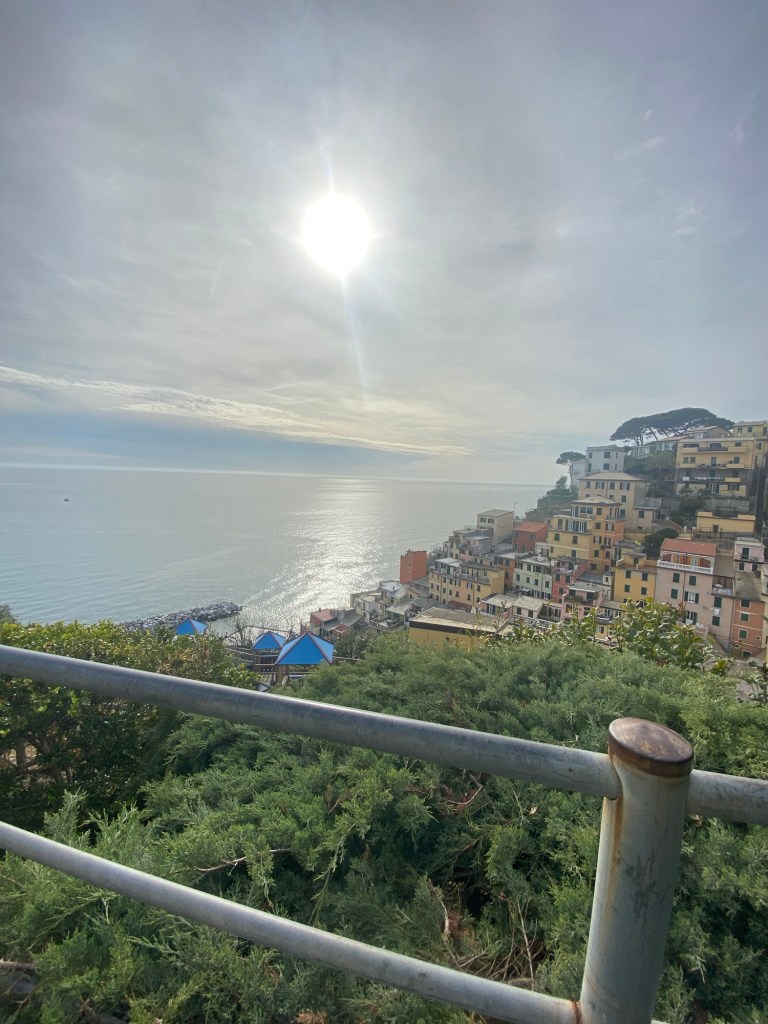
Was it at age 7, during a boat ride across Lago di Como? I had my first sip of champagne then. Someone shouted, ‘George Clooney’s house is somewhere over there!’
Was it at age 8, autumn time, horse riding in the Tuscan hills?
Was it at age 23? Was I meandering along the canals of Venice? Was I tilting my head as far as it would go to get the best view of Michelangelo’s masterpiece? Or was it when my breath got swept away by Duomo di Milano?
Was it at age 24? Was it during cinema Italiano in Piazza Maggiore? The sunset on Ponte Vecchio or that spritz in Trastevere?
Or was it at age 25? While getting lost in the narrow streets of Naples? Or perhaps watching the sunset atop Piazza di Spagna?
I can’t pinpoint the exact moment that I fell in love with Italy. All I can say is that Hemingway had it right when he said that “the Italians live all the way“.

But what exactly does that mean? To live ‘all the way‘? When many think of Italy, they think ‘La Dolce Vita’ or ‘Dolce far Niente’. Dolce, dolce, dolce… And while that is true to some extent, since the Italians are masters of beautifying the ordinary. We should look deeper. Beyond the sweetness of the aperol spritz. Beyond the quaint, postcard towns we see on Instagram. Beyond those elusive dance parties in the streets of Palermo. For in doing so, what we find is an Italy far different from the one modern society has ascribed to it. What we find, in my opinion, is an Italy far richer and more complex. La Vera Italia.
Italy has stolen a piece of my heart, that’s for sure. It has also found a way to inch itself into my daily subconscious. And so I write, not so much to give my ‘opinion’ on the places in Italy I’ve visited. Rather, I write to express how those places made me feel. To relay the points in time when, like Hemingway, I too observed the Italians living all the way.
Venice – The unreal city where, upon stepping off the train at Santa Lucia, nostalgia hits you like a truck…
In 2023, I was lucky enough to work in Italy as an Au Pair. Discussing how this experience changed my life would need a separate post. So, let’s stick to Venice for now. Though I wasn’t based in Venice at this time, I was a mere 30 minute train ride away. Next to my host family’s beautiful home in Treviso, I called Venice my second home. I must have visited Venice at least 10 times during my stay, maybe even more. I would be lying if I said it wasn’t an overwhelming place. Holding onto my bag for dear life across the Rialto bridge. Politely but sternly rejecting every “Signora, hai fame?” on Ruga dei Oresi. Resisting the urge to spend €100 on a gondola ride just to hear an Italian sing “That’s Amore”. Venice is a candy shop for tourists. Or at least, that’s how it comes across. The true Venice, the quiet Venice. That’s the Venice I remember.
To me, Venice started to feel true once I decided to ditch google maps and just get lost. Venice is the perfect starting point for the aspiring flâneur. There are no cars, so you don’t need to worry about traffic. And there is something to see around every corner, so you’re never left wondering, ‘what now?’
The Venetians are a true breed of their own. Proud. Forceful. And most of all, protective. Fiercely protective of their city, their ‘orange gem resting on a blue glass plate’ (Henry James). If you wander far enough, what you’ll find in Venice is something that most of us miss. Real life. Children walking to and from school, weighty backpacks slowing them down. The elderly shaking out their laundry over the canal. The lonely gondolier navigating the winding waterways in search of his next companion.
Roam aimlessly. Take an aperitivo in Cannaregio or Dorsoduro. Visit Ca’ Pesaro on a quiet Tuesday morning. Let your phone run out of battery so you can take a coffee while it’s charging. Try cicchetti con polpo at a local trattoria because there’s no way you’re trying it elsewhere. Let the melancholic beauty of Venice wash over you. For if you do, it will return the favour by showing you its magic.
Florence – The gem of the north. A city that simultaneously inspires and instructs…
August 2024 was not my first time in Florence. I was lucky enough to visit the city on a day trip from Lucca back in 2008. I don’t remember much from that first trip. All I remember is the view from the Duomo and how good that €3 bag of roasted chestnuts tasted. Fast forward 16 years later and there I was again. Only, I wasn’t with my family. I was alone. Alone in Florence in the peak of summer. There’s no denying it, Florence is, at its core, one of the most beautiful cities in Italy. Perhaps the world. But what happens if we put aesthetics to the side? If we set aside thinking about its artistic and cultural heritage? What’s left, then?
How do we talk about Florence without talking about art? Well, for me it’s pretty easy. When I was in Florence, I didn’t actively seek out art by going to galleries or museums. For one, my bank account would not allow it. Secondly, I wasn’t about to spend 2 hours waiting to see David when I could see him for free on Piazza della Signoria. I saw Florence the way I see all new cities I visit, by simply walking. One of my fondest memories was when I woke up early to watch the Mercato Centrale come to life. Seeing the merchants preparing their counters, descaling their espresso machines, chatting to one another. Those are the moments that stand out to me now. Seeing people seeing each other. Something else about the Florentine people is their dual sense of sophistication and warmth. From the complimentary watermelon courtesy of the friendly waiter at Bar Uffizi. The hotelier relaying her unadulterated love and knowledge of Florence to me at check-in. The striking waitress with whom I shared a joint appreciation for books and solo-travel. The taste of late-night gelato with Santa Maria del Fiore at one side, horses and coachmen at the other. Florence herself is, without a doubt, the art.
“You will begin to wonder that human daring ever achieved anything so magnificent” (John Ruskin, 1875). For in Florence, it was not my appreciation for art, culture, and history that was reaffirmed. Rather, it reaffirmed the concurrently comforting and empowering notion that one need only be human to create.
Rome – The eternal city which, upon your departure from it, plagues and blesses you with the eternal question, ‘when can I return?’
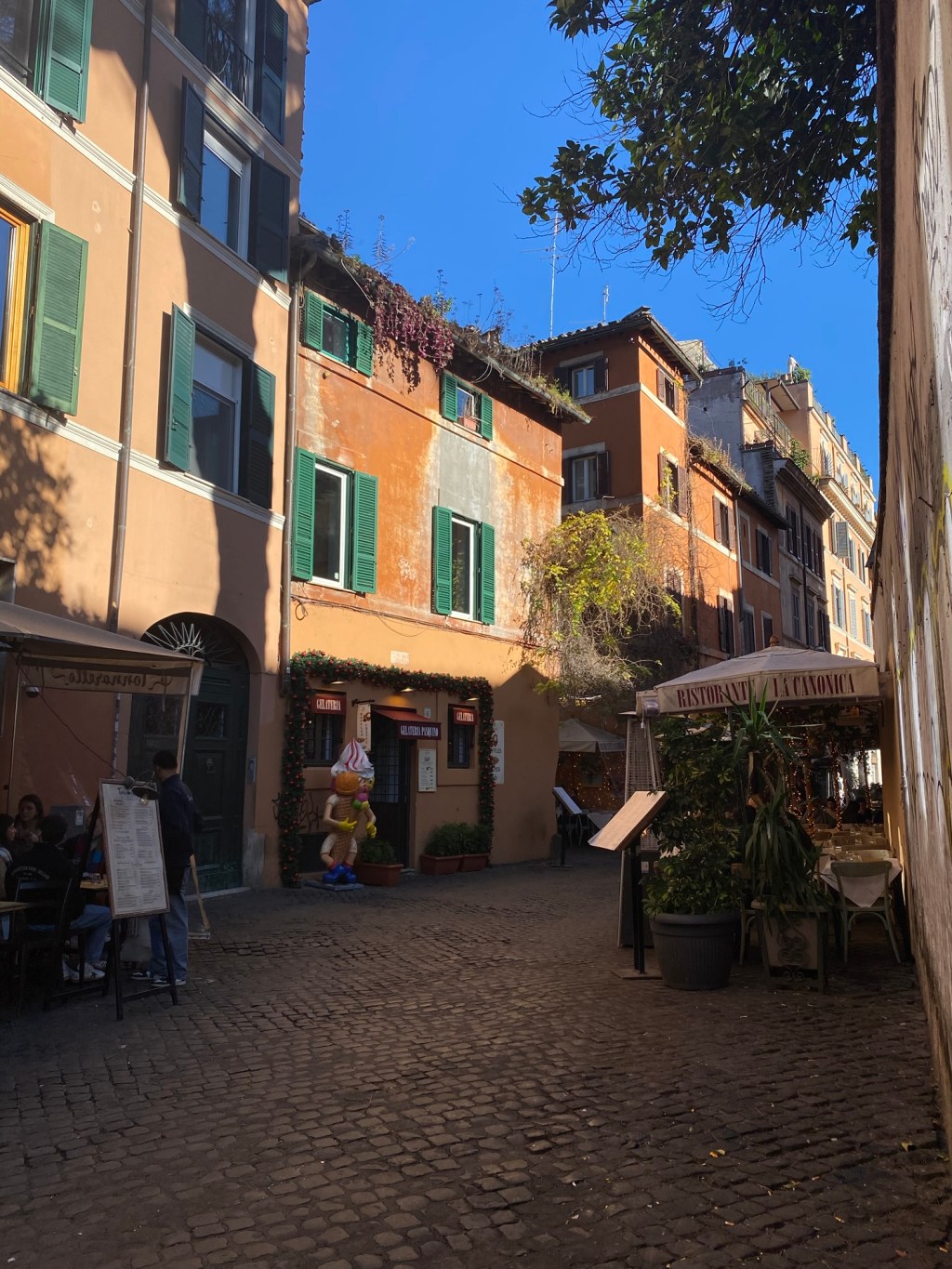
The famous proverb goes, ‘all bad things come in threes’. Well, I can safely argue the contrary when it comes to my experience of Rome. On my first visit to Rome, I fully embraced my tourist status. Waking up at ungodly hours to tour the Colosseum and the Vatican. Spending money on overpriced food and drink. Queuing for however many hours just to be, dare I say, underwhelmed by the Pantheon’s interior. There is so much I could have done differently on that first trip to Rome. But that is why there was a second. I reunited with Rome in the summer of 2024, after Florence. My goal that time around, ‘do as the Romans do’. But what do the Romans do, exactly? Surprisingly, I didn’t find the answer to that question in Trastevere. I found it in the quaint but beautiful neighborhood of Ripa. Nestled between Monti and Testaccio, Ripa is both local and affluent. What I found there was something so rare, something I’d only ever dreamed of… A pizzeria, in which, I was the only foreigner. All jokes aside, what I truly loved about Ripa was how quiet it was. I can still hear the cicadas singing in the pine trees as I walk to and from the historic centre. I can still vividly picture that one outdoor bar, illuminated by fairy lights. The one I never visited for fear of it being too local.
On my latest trip to Rome, I was a tourist again. Albeit, a more seasoned one. My third trip to Rome was the perfect amalgamation of culture and locality. One minute I was saying “Buongiorno” to a Roman walking her dog. The next I was admiring artwork in Galleria Borghese. The best part about visiting Rome for the third time? It was completely pressure free. Now, that’s not to say that I didn’t come away thinking, ‘oh, I should have made time to see that’, or ‘if I’d gone there, I could have done that’, etc., etc., etc. But what this particular trip taught me is that all these beautiful places – the ones I’ve seen and the ones I haven’t – are not going anywhere.
Rome is, like any other capital city, equal parts culture and craziness. And yet, it’s a type of craziness that is tolerable. If such a thing exists… Simply put, Rome is a city that ‘gets away with it’ because it’s Rome. Francesco Petrarca said that “a fool is one who admires other cities without visiting Rome”. Now, I’m the first to advocate for the underdog. But, when it comes to Rome, I cannot but simply agree with Petrarca. Once you encounter this city – soak in its sights, feel its history, experience the charm of its locals – you will know why it’s called the ‘eternal’ city. You will, whether you like it or not, eternally long for something you saw or something you felt, a Roma.
Naples – Italy’s unsung hero. A city so arcane, so paradoxical, it never truly leaves you…
I had never considered visiting Naples until very recently. Elena Ferrante’s portrayal of it in her Neapolitan Quartet is brutally beautiful. Without it, I wouldn’t have taken that train from Roma Termini. Thank god for you, Ferrante.
One can’t talk about Naples without talking about the sea. I vividly remember passing through Latina, Formia, and Aversa. In awe at the sight of the sea and, if I’m honest, taken aback by a version of Italy I hadn’t yet encountered. A version of Italy that is, for better or worse, rough around the edges. And yet, that’s what intrigued me. ‘What’s in store for me?’. ‘What will I do when I get there?’. ‘Will I be safe?’. Naples had consumed me before I’d even stepped off the train. That’s how I knew it was a city unlike any other. When I look back on my time in Naples, I am reminded of three things: those tapering streets, that constant looking over my shoulder, and finally, the people. Once I made it past Napoli Centrale, I quickly realised that all I had to do to get to the real Naples was, as always, to simply walk. Walk through Piazza Dante and down Via D’Alba – a street adorned with bookshops – and you quickly notice an aspect of Naples that many of us miss. A softness. One minute, you’re unnerved by a group of carabiniere, intimidatingly decisive. The next, you are watching an old Neapolitan man browse for books. That’s the beautiful paradox of Naples. You simply do not know what you’re going to see next.
“I have a concept of Naples that is not so much of a city, per se, but rather an ingredient of the human spirit that I detect in everyone, Neapolitan or not” (Luciano De Crescenzo). To say that I only scratched the surface of Naples would be an understatement. One cannot see Naples in a day. But if a day is all you have, what I can guarantee, with little to no doubt, is that you won’t be able to shake it.
“Love and understand the Italians, for the people are more marvelous than the land” (E.M. Forster).
So, when all is said and done, what is it about Italy? What did Hemingway mean when he said that the Italians ‘live all the way’? Now, I’m no expert, and I never will be. Why? Because I’m not Italian. But there is some virtue in that. For when an outsider observes the Italian going about their day, what they’ll find – whether it be in Rome or Naples – is one overarching quality. Authenticity.
Viva l’Italia.

 Writings of a Dreamer
Leave a comment